

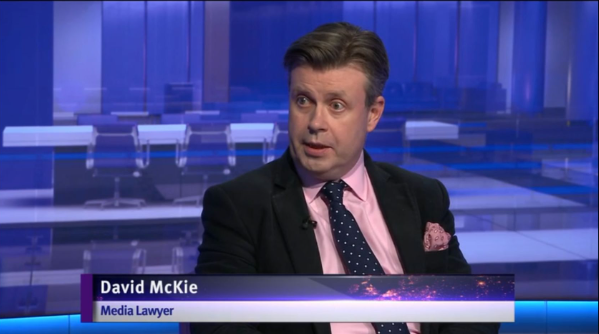
I was invited last week onto STV’s Scotland Tonight to discuss the David Walliams injunction case. Walliams unsuccessfully sought an order to prevent publication of an ITN/Guardian joint investigation into allegations that he had groomed teenage fans and engaged in sexual misconduct with them. He continues to deny the allegations.
Injunctions (in Scotland, Interdicts) are used in many different types of cases essentially as a mechanism to stop something happening. They are much more common than people might imagine and don’t exclusively apply to media stories. They are used regularly in neighbour disputes, in public law cases such as planning and in family cases.
This particular injunction was not the standard one might see where it is a straight battle between Article 8 (privacy) rights over Article 10 (freedom of expression).
The decision of Mr Justice Nicklin in PPT v Independent Television News Ltd and another is likely to assume significance well beyond the immediate facts of the case.
Since the turn of the millennium and the introduction of ECHR into UK law, UK courts have been asked to arbitrate on whether news articles involving celebrities, sex, misconduct and infidelity, could be stopped. The principles are now well-established. Freedom of expression, protected by Article 10 of the European Convention on Human Rights, carries particular weight where journalists are reporting matters said to be in the public interest. Injunctions are available where the privacy and family rights of the individual prevail over the media’s right to report.
The jurisprudence arising from privacy cases such as Mosley, PJS and, more recently, Bloomberg LP v ZXC, demonstrates both the power and the limits of the court’s willingness to interfere with publication.
Many such disputes and either attempts to stop stories, or the decision not to publish, never see the light of day. Such are the boundaries set by the courts these days that lawyers and media companies often reach agreement before the case ever reaches a court room. There is still a lot of self-policing which goes on, contrary to popular perception. Social media is an entirely different genre which is a relevant consideration, but with far less ability to police.
The application brought by David Walliams was different. The core issue was not privacy in the conventional sense. Instead, the claimant contended that publication of allegations being investigated by ITN and The Guardian would create a serious and immediate risk to his life and mental health. Psychiatric evidence before the court reportedly indicated a substantially increased risk of self-harm and suicide if publication occurred.
That placed the court in difficult territory. The claimant relied not merely upon Article 8 rights to privacy, but on Articles 2 and 3, concerning the right to life and protection against inhuman or degrading treatment. In essence, the court was asked to conclude that the risk posed by publication was sufficiently grave that it justified restraining investigative journalism altogether.
Nicklin J. declined to do so. While accepting the seriousness of the psychiatric evidence and the vulnerability of the claimant, he concluded that granting the injunction would amount to an exceptionally serious interference with freedom of expression. He also attached significance to the fact that the State had already assumed responsibility for the claimant’s immediate welfare through psychiatric detention and treatment.
For me as a Scottish media lawyer, the case inevitably evoked memories of another high-profile battle involving restrictions on publication. During the controversy surrounding the Ryan Giggs superinjunction, English courts had granted a superinjunction preventing identification of the footballer. Scottish publishers were not constrained because the order did not extend beyond Berwick. Indeed, the Sunday Herald proceeded to identify Giggs, illustrating a constitutional reality that is sometimes overlooked: Scotland has its own courts, its own legal system and its own law of contempt. The practical reach of English injunctions can become markedly more complicated once publication crosses jurisdictional boundaries.
That episode exposed a tension which remains relevant today. Information control has become increasingly difficult in an age of social media, international publication and instantaneous dissemination. Courts continue to possess formidable powers, but those powers operate within legal and territorial limits. The law must therefore balance competing rights while recognising the practical realities of modern communication.
The Walliams case illustrated a different but equally important aspect of that balance. There is little doubt that courts should take genuine psychiatric vulnerability seriously. Equally, there is a compelling public interest in ensuring that investigative journalism is not restrained merely because publication may be distressing or reputationally damaging. Were the threshold set too low, powerful individuals facing scrutiny could routinely deploy medical evidence in an attempt to delay or prevent publication of matters of legitimate public concern.
Viewed in that context, the judgment can be seen as a reaffirmation of a broader constitutional principle. Open justice and freedom of expression remain fundamental features of a democratic society. Even where the potential consequences of publication are exceptionally serious, courts will be slow to prevent reporting in advance unless the legal justification is overwhelming.
For Scottish practitioners, editors and journalists, the decision serves as another reminder that pre-publication interdicts remain rare, even although the remedy is widely used in other areas of the law. The legal argument deployed in this case was highly unusual. Yet the underlying question was familiar: where should the line be drawn between protecting an individual and preserving the public’s right to know?
Nicklin J’s answer suggests that, notwithstanding profound concerns about welfare and mental health, the courts remain reluctant to silence responsible journalism before publication. That is a message likely to resonate far beyond this particular dispute.
David McKie
14th November 2026
